

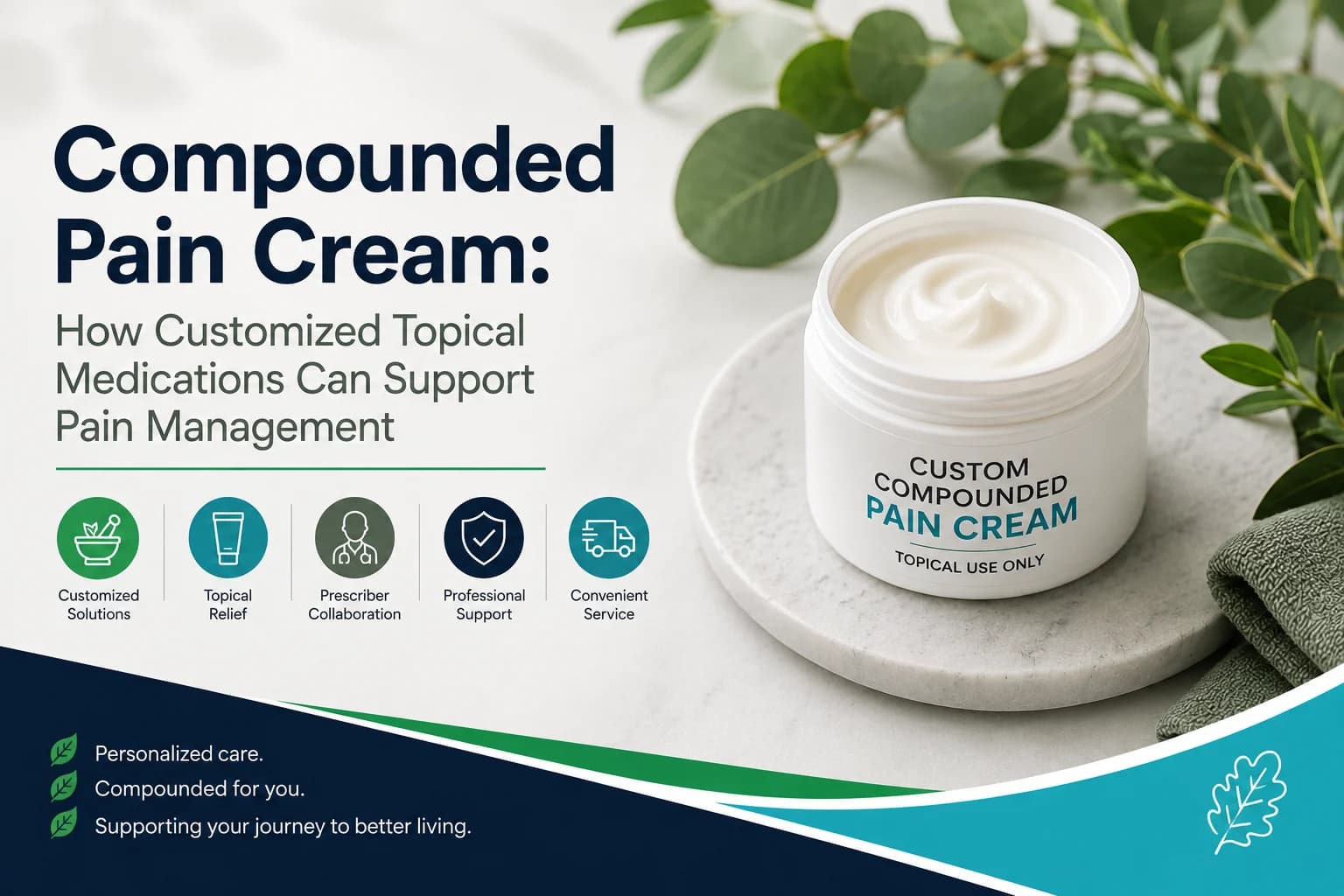
What Is a Compounded Pain Cream?
Pain can affect people in very different ways. The location of the pain, its severity, how long it has been present, and how a person responds to medication can all influence a treatment plan. Because of these differences, a medication that works well for one patient may not be the right option for another.
A compounded pain cream is a prescription medication prepared by a compounding pharmacy to meet a specific patient's needs when a commercially available medication may not provide an appropriate option. Unlike a standard product that is manufactured in a fixed form and strength, a compounded medication can be customized based on a prescriber's specific prescription.
For patients who have difficulty using certain oral medications or who may benefit from a topical approach, a physician may consider a compounded topical pain medication as part of an individualized treatment plan.
The goal is not simply to create a stronger medication. Instead, the purpose of compounding is to provide a customized medication when a patient's needs cannot be adequately met by an available commercial product.
At Oaks Compounding Pharmacy, pharmacists work with prescribers to support customized medication needs and help ensure that prescriptions are appropriate for the individual patient.
Why Would Someone Need a Custom Pain Cream?
Commercially available medications are designed to meet the needs of a broad patient population. However, healthcare is not always one-size-fits-all.
A patient may have specific medication requirements that make a standard product less suitable. For example, a prescriber may determine that a patient needs a particular dosage, strength, dosage form, or delivery format that is not commercially available.
This is where a custom pain cream may become an option. A physician or other authorized prescriber may consider compounded medication when there is a legitimate medical need for customization. The decision depends on the patient's individual circumstances and the prescriber's clinical judgment.
Potential reasons a prescriber may consider a customized topical medication include:
- A commercially available topical medication does not provide the desired dosage form
- A patient has difficulty swallowing oral medication
- A patient needs a customized strength
- A commercially available product is unavailable
- A patient requires a different medication format
- A specific prescription requires customization that is not available in a standard product
The important point is that compounded medication should be viewed as an individualized prescription option — not as a universal replacement for commercially available medications.
How Does a Compounded Topical Pain Medication Differ From Standard Products?
One of the biggest differences between a commercially manufactured topical medication and a compounded medication is customization.
Commercial medications are generally produced in standardized strengths, forms, and packaging. Those standardized options are appropriate for many patients, but they may not accommodate every individual situation.
A compounding pharmacy for pain can prepare a medication according to a prescriber's specific prescription when customization is medically appropriate. This can allow the prescription to address factors such as customized strength, dosage form, and individual medication needs.
Customized Strength
A prescriber may determine that a patient requires a specific strength that is not commercially available. Rather than selecting a standard strength that may not fit the patient's needs, a compounded prescription can be customized according to the physician's directions.
Customized Dosage Form
Some patients may have difficulty with certain dosage forms. A prescriber may determine that a topical form is more appropriate for a particular treatment plan.
Individual Medication Needs
Patients can have different medication histories, treatment goals, and tolerability concerns. A customized prescription can be designed around the individual requirements identified by the prescriber.
This is one of the reasons patients may seek a topical compounding pharmacy when a commercially available medication does not adequately meet their needs.
When Might a Doctor Consider Compounded Pain Medication?
There is no single condition that automatically means a patient needs compounded pain medication. Pain can result from many different causes, and treatment decisions should always be based on an individual's medical history and clinical evaluation.
Depending on the circumstances, a physician may consider topical medication as part of a broader treatment plan for certain types of localized discomfort. A compounded topical medication may be considered when:
- A patient needs an individualized prescription
- A standard commercial medication is not appropriate
- A specific strength is required
- A particular dosage form is medically appropriate
- A commercially available medication is unavailable
- The prescriber believes a customized formulation may address the patient's specific needs
The decision should always come from the prescribing healthcare professional. A compounding pharmacy does not replace the role of the physician. Instead, the pharmacy works alongside the prescriber to dispense the medication according to the prescription.
Compounded Pain Cream and Personalized Treatment
Personalization is one of the main reasons patients and healthcare providers may consider compounded medication.
Every patient has a different medical history. Some people may have tried several medications already. Others may have difficulty tolerating particular dosage forms. Some may require a strength or format that cannot be found in a standard commercial product. In these situations, individualized medication can give the prescriber another option to consider.
However, it is important to understand what personalization does — and does not — mean. A customized medication is not automatically more effective than a commercially available medication. It does not guarantee better results, faster relief, or fewer side effects.
Instead, the benefit of compounding is the ability to create a medication that follows a prescriber's individualized directions when a standard commercial option does not adequately meet the patient's needs. That distinction is important when discussing custom compounded pain medication.
Why Topical Medication May Be Considered
A topical medication is applied to the skin rather than taken by mouth. For some treatment plans, a prescriber may consider a topical approach because the medication is intended for application to a particular area.
The appropriateness of a topical medication depends on the specific medication, the patient's condition, the location of the problem, and the prescriber's clinical judgment. A topical medication is not appropriate for every type of pain, and patients should not assume that a topical product is automatically safer or more effective than an oral medication.
Instead, the choice between topical, oral, or another dosage form should be made with a healthcare professional. When a customized topical prescription is appropriate, a pain cream compounding pharmacy can provide the pharmacy support necessary to fill that prescription according to the prescriber's directions.
Have a prescription that calls for a customized topical formulation? Contact Oaks Compounding Pharmacy to coordinate with your prescriber.
The Role of the Prescriber in Compounded Pain Cream
The prescriber plays a central role in compounded medication. Before a compounded pain cream is dispensed, the healthcare provider determines whether customization is medically appropriate and specifies the prescription requirements.
This can include medication, strength, dosage form, amount, directions for use, frequency of use, and duration of treatment. The pharmacist then reviews the prescription and works within the scope of the prescription and applicable requirements.
This collaboration between the prescriber and pharmacist is particularly important when a medication needs to be customized. At Oaks, pharmacists work directly with healthcare providers to help ensure prescriptions are accurate and medications are appropriate for the patient's needs. Learn more on the Oaks Prescribers page.
Questions to Ask Your Doctor About a Compounded Pain Cream
If your physician is considering a compounded topical medication, it can be helpful to understand why customization is being recommended. Consider asking:
- Why is a compounded medication being considered?
- Is there a commercially available alternative?
- Why is a topical medication appropriate?
- What should I expect from the medication?
- How should I use the medication?
- What should I tell my pharmacist?
Your physician can explain what makes the customized option appropriate for your situation. Always follow the specific instructions provided by your prescriber and pharmacist.
What to Ask a Compounding Pharmacist
A pharmacist can also answer important questions about your customized prescription. Patients may want to ask:
- How should I use the medication?
- How should it be stored?
- What should I do if I miss an application?
- Are there special handling instructions?
- How long should I use the medication?
- What should I do if I experience an unexpected reaction?
- Who should I contact if I have questions about my prescription?
At Oaks Compounding Pharmacy, pharmacist consultation is an important part of the patient experience. The goal is to make sure patients understand their prescription and have access to professional pharmacy support when questions arise.
Why Choose a Compounding Pharmacy for Pain Management?
Choosing a compounding pharmacy is different from simply choosing a pharmacy that carries standard medications. When a prescription requires customization, patients need a pharmacy that understands individualized medication needs and can communicate effectively with the prescribing provider.
A good pain compounding pharmacy should provide:
The relationship between the patient, prescriber, and pharmacy can make the process easier and more organized.
Compounded Pain Cream in Sherman Oaks and Los Angeles
For patients looking for a compounding pharmacy in Sherman Oaks, Oaks Compounding Pharmacy provides customized compounding services designed around individual prescription needs.
Oaks serves patients in Sherman Oaks and the surrounding Los Angeles area with personalized medication services, pharmacist support, prescription coordination, and delivery options. Oaks Compounding Pharmacy's compounding pharmacy services include customized strengths and dosage forms, allergen-free formulations, specialized compounding, and other prescription-specific solutions.
For patients searching for a compounding pharmacy in Los Angeles, the most important consideration is not simply location. It is whether the pharmacy can appropriately support the individualized prescription and communicate with the prescribing provider.
How Oaks Compounding Pharmacy Supports Patients
At Oaks, customized medication is approached as a collaboration between the patient, prescriber, and pharmacist. When a patient has a prescription that requires customization, the pharmacy team can communicate with the prescribing provider when clarification or coordination is needed.
This can be particularly helpful when a prescription involves customized strengths, dosage forms, or other individualized requirements. Oaks also provides pharmacist consultations and convenient prescription services designed to make medication management easier.
For patients who need assistance with their prescriptions, the Oaks Compounding Pharmacy homepage provides more information about the pharmacy's services. Patients who have questions about customized prescriptions can also reach the pharmacy through the Contact Oaks Compounding Pharmacy page.
Is a Compounded Pain Cream Right for Everyone?
No. Compounded medication is not automatically the best choice for every patient or every type of pain. A compounded prescription is considered when there is a specific medical reason for customization and when the prescriber determines that it is appropriate.
For some patients, a commercially available medication may be the better option. For others, a customized prescription may provide an option that is not otherwise available. The right choice depends on the patient's individual situation.
That is why patients should speak with their physician rather than choosing a compounded medication solely because it is described as “custom” or “personalized.”
What Should Patients Know About Safety?
Patients should treat compounded medications with the same care and attention they give to any prescription medication.
Compounded drugs are not FDA-approved in the same manner as commercially manufactured drugs. The FDA does not pre-approve compounded drugs for safety, effectiveness, or quality before they are marketed.
This does not mean compounded medications have no legitimate role. Compounding can serve patients whose medical needs cannot be adequately met by an available commercially manufactured medication. However, patients should use compounded medications only when prescribed and should follow the directions provided by their healthcare professional and pharmacist.
If you have questions about your prescription, speak with your prescriber or pharmacist before making changes to how you use it.
Frequently Asked Questions About Compounded Pain Cream
What is compounded pain cream?
A compounded pain cream is a prescription topical medication customized by a compounding pharmacy according to a prescriber's specific directions when an appropriate commercial option may not meet the patient's needs.
Is compounded pain cream the same as regular pain cream?
No. Commercial topical medications are generally available in standardized forms and strengths. A compounded medication is customized according to an individual prescription.
Does compounded pain cream work better than commercial medication?
Not necessarily. Compounding provides customization, but it does not guarantee better effectiveness or results.
Can anyone get a compounded pain cream?
Compounded medications are prescription medications when prescribed as such. A healthcare professional must determine whether a customized medication is appropriate for the individual patient.
Why would a doctor prescribe a custom pain cream?
A doctor may consider a customized topical medication when a commercially available product does not adequately meet a patient's specific medical needs.
Where can I find a pain compounding pharmacy in Sherman Oaks?
Oaks Compounding Pharmacy provides customized compounding services in Sherman Oaks and supports patients and prescribers with individualized prescription needs.
Can a pharmacist change my prescription?
Patients should not ask a pharmacist to independently change a prescription. If a prescription needs clarification or modification, the pharmacist can communicate with the prescribing provider as appropriate.
Talk to Oaks About Your Compounded Medication Needs
Finding the right medication is not always about finding the most common product on the shelf. Sometimes, a patient's needs require a more individualized approach.
A compounded pain cream may be considered when a commercially available medication does not provide an appropriate option and a prescriber determines that customization is medically necessary. The process starts with the healthcare provider and continues with the pharmacist, who helps support the prescription and the patient's medication needs.
If you are looking for a compounding pharmacy in Sherman Oaks or Los Angeles, Oaks Compounding Pharmacy provides customized compounding services, pharmacist consultations, prescription coordination, and patient-focused pharmacy support. Explore compounding pharmacy services at Oaks, or read our guide to when one-size-fits-all medications don't work.
Have a prescription for a customized pain cream?
Talk with an Oaks pharmacist about your prescription, prescriber coordination, and free local delivery.
Oaks Compounding Pharmacy | 13322 Riverside Dr., Sherman Oaks, CA 91423 | Free local delivery
This article is for general educational purposes only and is not a substitute for professional medical advice, diagnosis, or treatment. Compounded medications should be used only under the direction of an appropriately licensed healthcare professional. Individual treatment decisions depend on the patient's medical history, condition, and prescription requirements. Always follow your prescriber's and pharmacist's instructions regarding your medication.